Problem and solution
Defining experiments in Route definitions, part 1/2
Pulling experiment logic out of several files and into the route definitions.
This is a pull request I opened at InterNations. It is laid out below the way my colleagues would have come across it: as a review page, at the point where they had to decide whether to take the change on.
The description is the part on display here. The diff that went with it is private, and links to the repository and to our internal tools are flattened to plain text, so nothing below will take you somewhere it shouldn’t.
Defining experiments in Route definitions, part 1/2#6263

For routes that are controlled by an experiment, the experiment can be configured within the route definition.
This change comes from our Campfire discussion on 2024-01-18.
Highlights
- Each route definition now specifies if the route is guarded by an experiment (instead of spreading this logic across multiple files)
- Tests are now automated
Problems we’re trying to solve
How can we be sure that experiments/segmentation are respected while a user navigates around within the SPA?
Issues:
- Currently, linking to a route with
<INLink>will respect any experiment logic. But usingroute.go()will not respect experiment logic. - There is no single source of truth. Route definitions are separate from their experiment logic (which is defined in
useIsSpaAllowedAccordingToExperiment) - Longterm, we cannot rely on the browser regularly “checking in” with the backend to ensure that experiment logic is respected (i.e. by doing a full page reload that touches Symfony). The SPA itself needs to be aware of how experiments affect navigation.
Solution
Each route’s definition can now contain information about experiments.
How to define the experiment for a route
For example, we will only use SPA navigation when going to this route if the user is in sa18=B.
export const createEvent = new Route({ path: '/event/review/suggest', experiments: { allowSpaNav: { name: 'sa18', segments: ['B'], }, },})If the user is in sa18=A (or C, or not segmented at all), we will navigate using standard browser navigation (<a href="...">) so that Symfony will handle the request.
Multiple segments can be listed.
Other experiment configuration and tests
Previously, when setting up a new experiment, devs also had to modify useIsSpaAllowedAccordingToExperiment and isUrlAllowedByExperiment to apply the logic for their experiment. This is no longer necessary. The experiment logic will take effect just by updating the route definition as shown above.
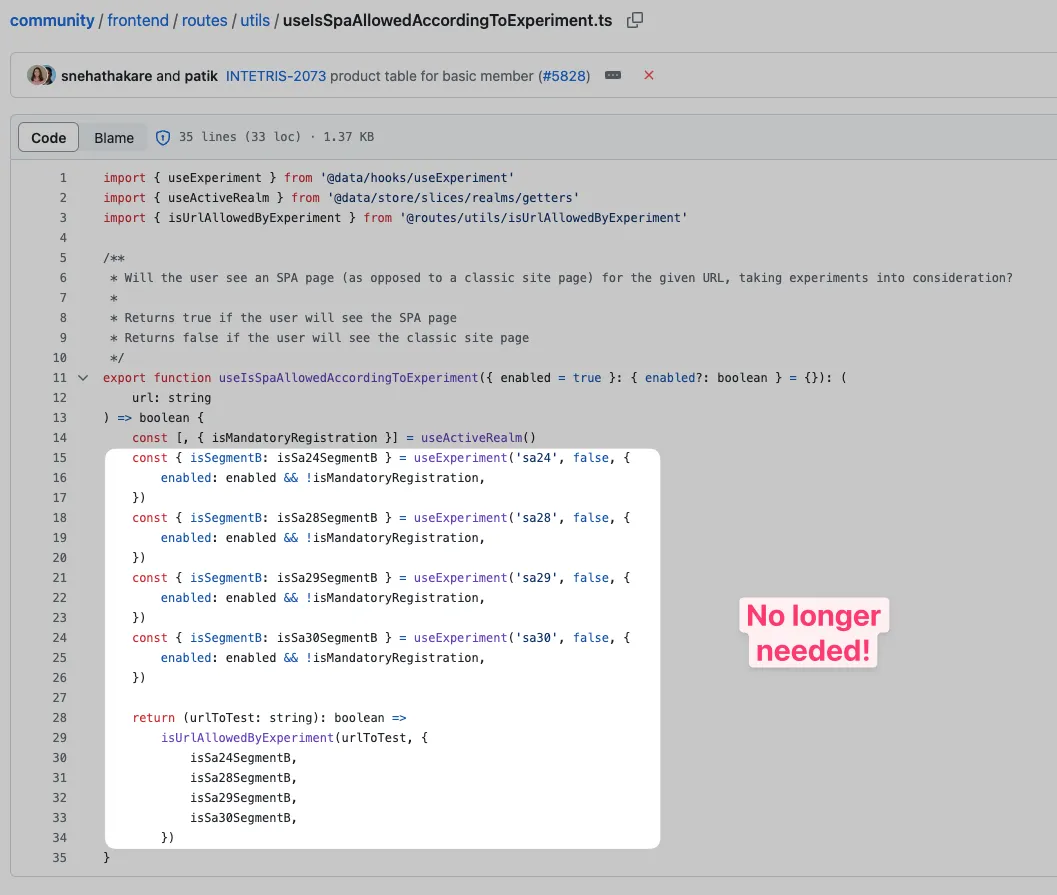
Additionally, tests are now automated. The old file frontend/routes/utils/isUrlAllowedByExperiment.test.ts, which required manual updates, is no longer necessary. Now, frontend/routes/catalog/experiments.test.tsx will run tests across all route definitions and segments. There is also no need to cleanup the tests when the experiment ends.
Behavioral changes
To push, or to replace?
There is an existing function getRouterMethod() that determines whether we should use router.push() or router.replace() to navigate to a route. Previously, this function was only used when calling .go(). I believe this was an oversight. We now also call getRouterMethod() within <INLink> (i.e. when the user clicks on a link).
Possible ‘gotcha’ in some tests
We have some tests that follow this pattern:
ARRANGE: Create some component with a link in it ACT: Render the component and click on the link ASSERT: router.push or router.replace should have been called
In some cases, the SPA may need to look up experiment info for these links. If the test did not already mock the requests to /api/experiment/participation then the test now fails. This is because the route can’t be sure the user is in the correct segment, so instead of using NextRouter, it uses regular browser navigation. The fix is to mock the API request.
To be clear, these issues are already fixed in this PR; this is just something to keep in the mind for writing tests in the future.
What’s included in this PR
<INLink> is updated to support the new pattern
What will be in the next PR #6250
Route.go() will be updated to support the new pattern
Replacement PR for #6247 which I accidentally merged before it was ready or reviewed